
close
Choose Your Site
Global
Social Media
Views: 0 Author: Site Editor Publish Time: 2026-10-08 Origin: Site


Many procurement teams fall into a common trap. They assume higher carbon black loading automatically equals a better product. Buyers often believe a 50% pigment ratio offers more value than a 40% blend. This misconception frequently leads to expensive manufacturing failures. You must look beyond simple percentages to understand true material quality. The real measure of performance lies elsewhere.
We introduce dispersion as the actual critical factor in plastic manufacturing. It directly dictates color intensity. It ensures mechanical strength. It also maintains essential UV stability in your polymer applications. If particles clump together, your entire production run suffers. This article provides a concrete framework for material selection. We will help engineers and procurement teams accurately evaluate quality. You will learn to mitigate processing risks effectively. Finally, we guide you in selecting the right formulation for your specific needs. Understanding this dynamic completely changes how you approach material sourcing.
Manufacturers often discover the true cost of poor materials on the factory floor. Low-quality mixtures create cascading failures during daily operations. These issues quietly destroy profit margins and frustrate production teams. We must examine the direct operational consequences of undispersed pigment agglomerates.
Undispersed agglomerates wreak havoc on extrusion machinery. These hard clumps of carbon fail to pass through standard filtration systems. They rapidly accumulate on the extruder screens. This buildup leads to severe screen pack clogging. Operators must frequently halt machinery to perform maintenance and replace screens. Every minute of this unplanned downtime costs money. You lose valuable production hours. You also increase the wear and tear on your equipment.
Poor dispersion directly causes visible surface defects. These defects ruin the aesthetic and structural integrity of the final product. You will often see specks or dark streaks in the plastic. In film applications, these agglomerates create "fish eyes" on the surface. Quality assurance teams have no choice but to reject these flawed batches. High QA rejection rates lead to massive material waste. You end up throwing away expensive base polymers because the colorant failed.
Buying cheap materials often creates a false economy. Poorly dispersed formulations lack proper tinting strength. The pigment remains trapped in tight clumps. It cannot spread evenly to color the surrounding plastic. To compensate, manufacturers often increase their dosing rates. They use significantly more black masterbatch just to achieve the desired opacity. This overcompensation completely negates any initial cost savings from the cheaper purchase price.
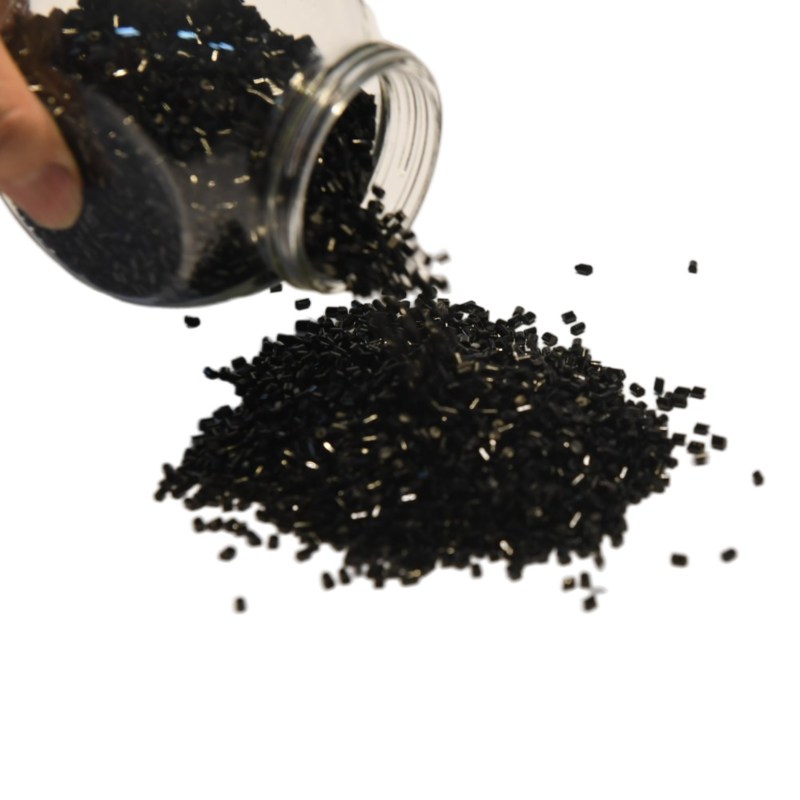
The physical properties of your final product depend heavily on how well particles mix. A uniform distribution transforms the baseline capabilities of the host plastic. Agglomerates do the exact opposite. They introduce severe structural and functional weaknesses into the material. We can observe these impacts across several key performance categories.
Well-dispersed fine particles act as a powerful shield against the sun. They absorb and scatter UV radiation effectively. This mechanism is critical for agricultural films and outdoor pipe applications. When particles spread uniformly, they protect the entire polymer matrix. Agglomerates fail to provide this coverage. They leave large microscopic areas of the polymer completely exposed. These unprotected zones degrade rapidly under sunlight. The plastic eventually becomes brittle and fails prematurely.
Large, undispersed carbon clumps act as dangerous stress concentrators. They sit within the polymer matrix like rocks in a stream. When the plastic bends or stretches, mechanical stress focuses on these rigid clumps. This concentration significantly reduces the overall impact strength. It also severely limits tensile elongation. Products break or tear at much lower thresholds than expected. A smooth, even distribution ensures the plastic retains its original flexibility and strength.
Specialized applications sometimes require conductive compounds. These materials must conduct electricity safely and predictably. Uniform distribution remains absolutely required here. The particles must form a consistent electrical percolation network. They need to connect evenly throughout the plastic. Poor mixing breaks this delicate network. It creates dead zones and unpredictable electrical resistance without degrading the host plastic.
Performance Impact: Optimal vs. Poor Distribution
| Performance Metric | Optimal Distribution | Poor Distribution (Agglomerates) |
|---|---|---|
| UV Resistance | Excellent absorption; long lifespan | Patchy coverage; rapid polymer degradation |
| Impact Strength | Maintains base polymer strength | High stress concentration; brittle failures |
| Surface Finish | Smooth, glossy, and uniform | Visible specks, streaks, and fish eyes |
| Color Opacity | High tinting strength at low doses | Weak tinting; requires over-dosing |
Standard data sheets often hide the true nature of a product. They highlight broad specifications but ignore microscopic realities. You must look beyond standard marketing claims. Evaluating true quality requires a deeper understanding of material science. We must focus on operational metrics and strict compatibility rules.
Buyers often fixate on the loading percentage. They assume a higher number is always better. We must clarify this dangerous misconception. A 40% carbon loading with superior mixing will easily outperform a 50% loading with poor mixing. The 40% blend utilizes every single particle efficiently. The 50% blend wastes material in useless clumps. You get better color, better strength, and fewer processing headaches from the well-mixed 40% formulation.
You cannot judge quality by eye alone. You need standardized metrics to verify the internal structure of the compound. We strongly recommend using two specific assessment methods.
You must match the carrier resin to your specific polymer matrix. This step remains non-negotiable. Discuss the importance of the carrier resin’s Melt Flow Index (MFI). The MFI of the carrier must align closely with your base polymer. This alignment ensures seamless integration during the melting phase. If the MFI values clash, the materials will not blend. This incompatibility causes secondary agglomeration, ruining even the highest quality carbon black dispersion during final extrusion.
Theoretical quality means nothing if the material fails on the factory floor. The extrusion process introduces intense heat and physical shear. Poorly mixed materials force operators to make dangerous processing compromises. These compromises often damage the final product irreparably.
Operators hate clogged screens and weak coloration. They often try to fix these issues by adjusting machine parameters. They run extruders at higher shear rates and much higher temperatures. They hope this extra energy will force the bad clumps to break apart. This aggressive strategy introduces a massive risk. The extreme heat and friction can easily degrade the base polymer. The plastic loses its molecular integrity before it even leaves the die.
Modern factories rely on high-speed, automated feeding systems. These systems demand absolute consistency. Maintaining consistent coloration becomes incredibly challenging when using low-quality materials. Automated feeders struggle to maintain precise let-down ratios if the pellet density or dispersion varies. One batch might look perfectly black. The next batch might look gray and streaky. This inconsistency causes chaos for quality control teams.
Environmental factors also play a major role in processing success. Some highly loaded formulations act like sponges. They can absorb significant moisture if not processed or stored correctly. This hidden water causes massive problems during extrusion. When the wet pellets hit the hot extruder barrel, the water instantly vaporizes. This steam creates lacing, surface voiding, and bubbling in the final plastic. It compounds existing mixing issues and ruins the structural integrity of the part.
Selecting a new supplier requires rigorous validation. You cannot simply accept their sales pitch at face value. You must implement a strict testing protocol. This structured approach protects your production line from catastrophic material failures.
Buyers must take control of the conversation early. Advise your procurement team to ask suppliers for detailed historical data. You need proof of batch-to-batch consistency. Do not accept a single successful test report. Ask for specific FPV test results across multiple recent production runs. Furthermore, request application-specific pilot data. A formulation that works for thick injection molding might fail miserably in thin blown film. Demand evidence relevant to your specific process.
Never roll out a new formulation blindly. Outline a strict, small-scale validation process before full production. This protocol ensures the material behaves as promised under your exact factory conditions.
By forcing suppliers to pass this pilot protocol, you eliminate the risk of introducing incompatible materials. You ensure the black masterbatch fits your exact engineering parameters perfectly.
We must reiterate that proper particle distribution acts as the absolute linchpin of manufacturing. It drives both factory efficiency and long-term product reliability. High loading percentages mean nothing if the material cannot spread evenly through your base polymer. Undispersed clumps will clog your screens, ruin your aesthetics, and destroy your mechanical properties.
Evaluating these materials requires a strict engineering mindset. You must focus intensely on carrier compatibility. You must rely on testable metrics like FPV and microscopic analysis. You must prioritize long-term production stability over simple upfront price tags. Real value comes from smooth, uninterrupted extrusion runs and zero quality rejections.
Do not let poor materials dictate your production success. We encourage readers to request a technical consultation today. Ask your supplier for a sample tailored directly to your specific base polymer. Review specialized product literature to better understand the microscopic realities of your raw materials. Take control of your sourcing strategy now.
A: Loading is the total percentage of carbon black by weight in the masterbatch. Dispersion refers to how evenly and finely those individual particles are distributed within the carrier resin. High loading is useless without excellent dispersion.
A: It directly causes surface roughness and visible specks. It creates weak spots that are highly prone to tearing during use. It also results in inconsistent opacity, causing the film to look streaky or patchy.
A: It depends heavily on the application. Highly demanding thin films require a drastically lower FPV to prevent tearing. Thick-walled injection molded parts can tolerate a slightly higher FPV. Always benchmark against your specific application requirements.
A: Only marginally. While high shear can break down some soft agglomerates, relying on the extruder to fix fundamental material flaws is dangerous. It risks severe thermal degradation of your base polymer and severely limits your overall production speeds.
