
close
Choose Your Site
Global
Social Media
Views: 0 Author: Site Editor Publish Time: 2026-09-22 Origin: Site


Every plastics manufacturer faces a critical dilemma on the production floor. Do you choose lower-cost universal carrier resins for color blending? Or do you risk part failure in specialized polymer processing just to save money? Off-the-shelf carriers like polyethylene (PE) or ethylene-vinyl acetate (EVA) offer undeniable convenience. They remain highly affordable for bulk production. Conversely, polymer-specific custom carriers demand detailed upfront engineering. Manufacturers frequently default to standard carriers without assessing long-term processing risks.
Customizing your carrier is not always strictly necessary. However, failing to do so in high-stress, engineered, or precise injection molding applications proves disastrous. You risk severe delamination, poor dispersion, and catastrophic mechanical degradation. This guide reveals exactly when standard universal carriers fall short. You will learn how to identify critical processing thresholds effectively. Mastering this decision ensures product integrity while maximizing overall production efficiency.
Manufacturers often start their formulation journey using universal carriers. Standard EVA or PE carriers make complete commercial sense for basic applications. They handle commodity goods perfectly. They work beautifully for non-structural packaging components. If you run low let-down ratios, you rarely need custom formulations. You save money upfront. Production stays simple. Supply chains remain uncomplicated.
However, using mismatched carriers introduces severe financial risks. Rigid engineering specifications expose the hidden costs of incompatibility. You might see weakened tensile strength in the final molded part. Scrap rates can skyrocket unexpectedly. Machine downtime increases as operators fight unstable processing parameters. We see companies lose thousands addressing sudden molding defects caused by poor carrier choices.
You must frame this technical decision around the total cost of quality (TCQ). Custom carriers indeed cost more initially. Yet, they drastically reduce rejection rates in critical applications. A perfectly matched carrier eliminates delamination risks completely. Your production runs smoother. Quality control passes more parts reliably. This return on investment easily justifies the initial customization expense.
Common Mistake: Evaluating material costs purely on a per-kilogram basis while ignoring the increased labor costs tied to elevated scrap rates.
Polymer compatibility has absolute chemical limits. Mixing a PE-based carrier into Polycarbonate (PC) or PET frequently causes phase separation. These base polymers possess vastly different molecular structures. They reject foreign resins during the cooling phase. This rejection forms distinct microscopic layers inside the part.
Custom polymer-specific carriers solve this challenge entirely. They ensure completely homogeneous blending. The custom formulation melts seamlessly into the primary matrix. You retain the base polymer's original thermal properties. The mechanical strength remains uncompromised. Always match the carrier chemistry to the base matrix for engineered plastics.
High pigment-to-resin ratios alter the physics of melting. Heavy pigment loads demand exceptional carrier performance. You must coat every single pigment particle evenly. Poor wetting leads directly to pigment agglomeration. These clumps block mold gates and cause surface defects.
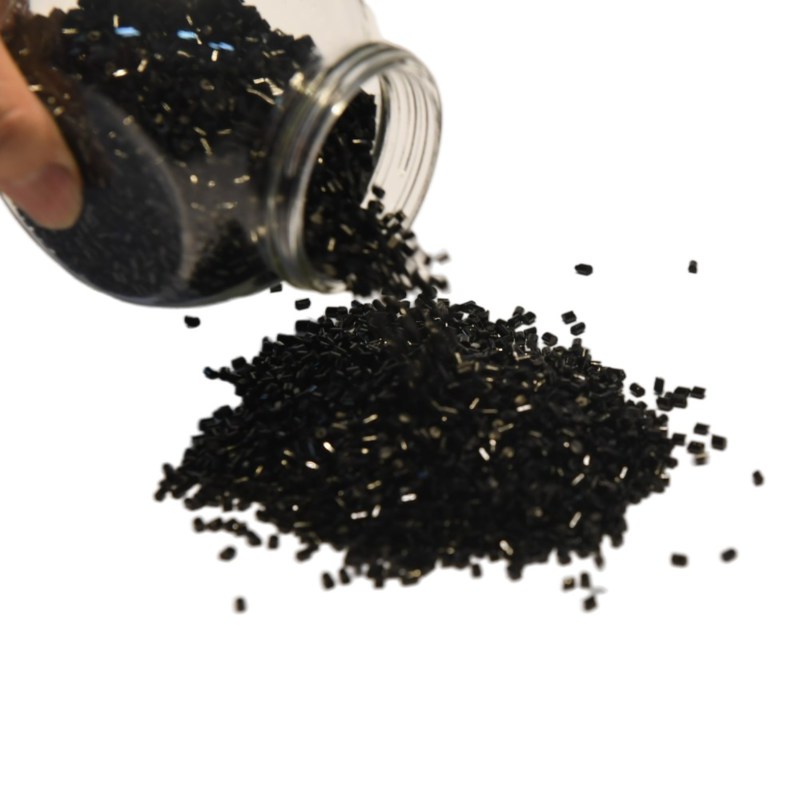
Manufacturing a great quality black masterbatch with high carbon black loading requires precise engineering. You need a custom carrier designed for superior wetting. This ensures flawless dispersion across the entire polymer matrix. The result is deep, uniform jetness. You completely avoid structural weak spots caused by un-melted clumps.
High shear rates test material limits aggressively. Complex mold cavities demand perfect flow behavior. Off-the-shelf carriers often fail under high-pressure injection molding. They separate from the primary polymer due to varying shear sensitivities.
Custom carriers directly prevent frustrating cosmetic defects. You eliminate flow marks and surface streaking. Structural delamination, often seen as surface peeling, becomes a non-issue. The customized resin moves identically to the base material. The final molded part looks perfect and performs flawlessly under stress.
Regulated industries leave absolutely no room for error. FDA food contact approvals require pristine material chains. USP Class VI medical devices demand absolute purity. Strict automotive standards enforce rigorous UV stability rules. Chemical migration is completely unacceptable in these sectors.
Customizing the carrier guarantees full traceability. You maintain continuous compliance alongside the base resin. The medical or automotive auditor sees a unified material profile. You avoid regulatory failures caused by unknown carrier additives found in universal batches.
Selecting the perfect formulation requires deep technical diligence. You must evaluate key processing parameters carefully. Let us explore the primary specifications you need to measure for production success.
MFI dictates how materials blend inside the barrel. We follow a strict rule of thumb in plastics engineering. The masterbatch carrier resin MFI should be slightly higher than the base polymer. This ensures the masterbatch melts first. It quickly encapsulates the base material. Proper MFI alignment prevents un-melted color specks. It ensures smooth transitions across varying mold zones.
Thermal stability is completely non-negotiable. The carrier must withstand the base polymer's processing temperature. It cannot degrade under intense heat. Off-gassing creates structural voids in the molded part. Thermal yellowing ruins lighter color profiles. Always align thermal degradation points accurately to prevent burnt material.
The percentage of masterbatch dictates your carrier choice heavily. Higher LDRs introduce significant processing risks. They cause base resin dilution. A 10% LDR of a mismatched carrier weakens the structural matrix noticeably. Greater masterbatch volumes strictly demand custom carriers. Low LDRs usually tolerate universal carriers safely.
| Let-Down Ratio (LDR) | Carrier Recommendation | Primary Processing Risk |
|---|---|---|
| Under 2% | Universal (PE/EVA) | Low risk; acceptable for commodity goods. |
| 2% - 5% | Evaluate Base Polymer | Moderate risk of phase separation in engineering resins. |
| Above 5% | Custom Polymer-Specific | High risk of mechanical degradation and delamination. |
Best Practice: Always request a differential scanning calorimetry (DSC) report to verify melting point alignments between your base resin and the proposed carrier.
Moving to a custom formulation involves strategic trade-offs. You must evaluate operational hurdles alongside the clear engineering benefits. Understanding these factors prevents budget overruns.
Custom batches inherently require higher MOQs. Off-the-shelf standard masterbatches offer small batch flexibility. Custom compounding lines need larger runs to remain profitable. You must plan production schedules around these industry hurdles. Discuss MOQ tiers early during contract negotiations to optimize cash flow.
Engineering perfection takes considerable time. Account for the extended periods required for precise color matching. Plaque testing demands rigorous laboratory hours. Physical property validation ensures mechanical safety. You cannot rush the initial formulation phase. Standard carriers ship immediately. Custom carriers need thorough validation cycles.
Warehouse space represents real operational capital. Specialized inventory requires careful tracking. You lose the simple convenience of universal SKUs. Standard carriers allow one product across multiple lines. Custom carriers restrict usage strictly to specific base polymers. You must balance this complexity against lower rejection rates.
Selecting the right manufacturing partner determines your ultimate success. You need a company capable of executing precise chemistry. Evaluate potential partners using these specific criteria.
Standard universal carriers remain cost-driven choices. They suit commodity plastics perfectly well. Custom carriers represent performance-driven solutions. They dominate engineered and high-stress applications. You base this choice entirely on the mechanical demands of the final part.
Technical buyers and engineers must align early. Bring your exact base resin specifications to the table. Detail your precise processing parameters clearly. Do this before you ever request a color match. Clear communication prevents weeks of wasted formulation time.
Do not let a minor carrier incompatibility ruin your next production run. Consult your engineering team today. Audit your current resin compatibility thoroughly. Reach out to expert formulators to discuss custom solutions tailored strictly to your polymer matrix.
A: While possible for basic applications, a high-performance black masterbatch used in UV-exposed or structural parts usually requires a polymer-specific custom carrier to maintain impact strength and achieve deep jetness without streaking.
A: It leads to un-melted masterbatch particles, poor color dispersion, weak spots in the molded part, and potential blockages in the die or mold gates.
A: Pre-colored resin guarantees 100% compatibility but carries high costs and strict MOQs. Customizing the masterbatch carrier resin offers a middle ground. You get perfect compatibility at the molecular level while maintaining the cost-efficiency and flexibility of processing natural resins on the floor.
