
close
Choose Your Site
Global
Social Media
Views: 0 Author: Site Editor Publish Time: 2026-04-03 Origin: Site


A cable can look fine and still fail too soon. The right masterbatches for cables affect processing, insulation performance, weather resistance, and service life. In this article, you will learn which features matter most when choosing masterbatch solutions for cable insulation and jacketing in real production.
In cable manufacturing, the earliest screening criteria are usually the most decisive. Before buyers compare color precision or additive packages, they need to confirm whether a masterbatch can run cleanly with the target polymer, disperse evenly in a thin insulation layer, and stay stable across the actual extrusion temperature range. These basics directly influence appearance, throughput, and the physical reliability of the finished cable. Cable compounds often work with polymers such as PVC, PE, PP, HDPE, LDPE, LLDPE, and nylon, so compatibility cannot be treated as a secondary check.

Carrier resin compatibility determines whether the masterbatch becomes part of the cable compound smoothly or behaves like a foreign phase during extrusion. When the carrier is aligned with common cable resins such as PVC, PE, PP, HDPE, LDPE, LLDPE, or nylon, the formulation is more likely to support stable melt blending, uniform appearance, and predictable mechanical behavior. If compatibility is weak, the result may not be dramatic at first glance, but it often shows up as rougher surface finish, unstable flow, weaker physical performance, or inconsistent sheath quality in production. For cable manufacturers, this means the carrier system should be reviewed with the same seriousness as pigment loading or additive type, especially when the product will be used in insulation or outer-jacket applications.
Selection point | Why it matters in cable extrusion |
PVC / PE / PP / nylon compatibility | Helps the masterbatch blend more uniformly with the base resin |
Stable melt behavior | Supports smoother extrusion and fewer process interruptions |
Surface finish consistency | Reduces visual defects on insulation and sheathing layers |
Physical property retention | Lowers the risk of weakening the final cable structure |
Dispersion quality becomes even more critical in cable production because insulation layers are often thin and extrusion speeds are high. Under these conditions, there is very little room for pigments or additives to remain unevenly distributed. A well-dispersed masterbatch promotes cleaner color development and more stable visual quality across long runs. Poor dispersion, by contrast, can create streaks, specks, or patchy color distribution that immediately affect product appearance and may increase rejection rates. In practical terms, better dispersion is not just a cosmetic benefit; it also helps reduce production waste and makes line performance more predictable.
Thermal stability is another basic requirement because cable masterbatches must tolerate processing heat without discoloration, decomposition, or loss of functional performance. Cable extrusion temperatures commonly fall around 160–220°C, while some PE-based systems may demand even higher resistance. That means a masterbatch suitable for one polymer family may not perform equally well in another. PVC applications often prioritize color retention and controlled heat history, while PE or related systems may require broader thermal endurance. In practice, stable formulations help protect shade consistency, extrusion behavior, and long-run process reliability.
Once compatibility and processing basics are confirmed, the next step is to evaluate what the masterbatch actually adds to cable performance in service. In cable manufacturing, functional features are not decorative extras. They influence identification accuracy, outdoor durability, safety behavior, and long-term stability under real operating conditions. Color consistency, UV resistance, oxidation control, flame-retardant support, antistatic performance, reduced odor, and flexibility enhancement are all practical targets in cable formulations.
Stable color performance matters because cable color is often used as a working identification system, not just a visual choice. In power, telecom, and industrial cable production, manufacturers depend on repeatable shades to distinguish cable functions, phases, or installation categories. If a formulation drifts from one batch to the next, the issue affects not only appearance but also production control, especially in large-volume runs where even slight variation becomes highly visible. Cable masterbatches are expected to support standard-based color matching, which makes shade repeatability part of product consistency rather than a cosmetic preference. High tinting strength and even pigment distribution help maintain that consistency while keeping addition rates controlled.
Functional feature | Why it matters in cable applications |
Color consistency | Supports clear cable identification and stable batch-to-batch production |
UV and weather resistance | Helps outdoor cables resist fading, cracking, and embrittlement |
Flame-retardant support | Improves suitability for fire-sensitive cable environments |
Antistatic performance | Reduces static build-up in applications where charge control matters |
Flexibility and odor control | Improves handling, installation behavior, and end-use comfort |
Outdoor and exposed cables face continuous stress from sunlight, oxygen, heat, and changing weather conditions. Without the right stabilizer package, polymers can lose flexibility, fade, crack, or become brittle over time. That is why UV-resistant and aging-resistant masterbatch formulations are especially relevant for power distribution, communication, and other exterior cable uses. In practice, this means the masterbatch should be evaluated not only for initial appearance but also for its ability to preserve cable integrity after prolonged environmental exposure. A formulation that looks stable at the extrusion stage may still perform poorly if it cannot resist photo-oxidative aging in the field.
Some cable applications need more than color and weatherability. They also require additive support tied to safety performance. Flame-retardant masterbatches are used where cables must better resist ignition or reduce fire risk, while antistatic options may be relevant when static accumulation could create handling or operational concerns. Reduced odor and flexibility enhancement are also practical formulation targets, especially where cable materials are processed or installed in controlled environments. These properties should be selected according to actual cable requirements, not added by default. A cable intended for indoor electronics, for example, may prioritize odor and flame behavior differently from one intended for outdoor power use.
Beyond the core features, cable formulations may also be tuned for more specific service demands. Improved flexibility can help cables withstand bending or repeated movement, while better durability may be needed in automotive, communication, or high-exposure environments. Additive masterbatch options are often customized according to application needs rather than offered as fixed packages. That approach is useful because the most effective feature set is usually the one that matches the cable’s actual operating conditions. Adding more functions than necessary can increase complexity without improving practical performance.
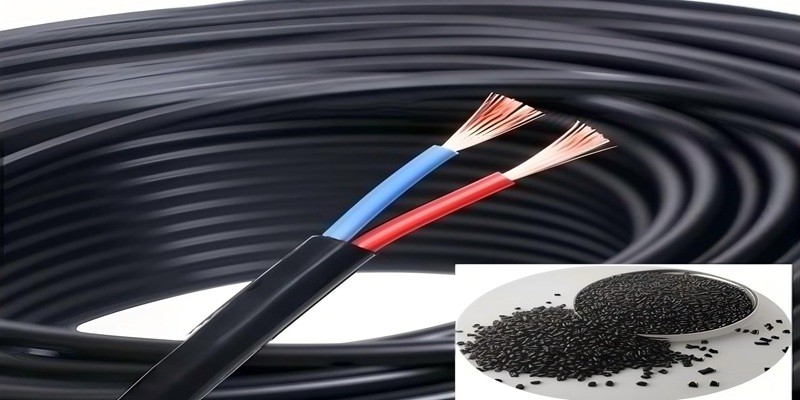
In cable compounds, visual quality and processing ease are not enough on their own. Buyers also need to check whether a masterbatch preserves insulation performance, avoids conductive contamination, and remains stable inside layered cable structures over time. These points are core technical requirements because cable masterbatches should support strong insulation, signal integrity, controlled impurity levels, and zero-migration behavior rather than simply delivering color or additive loading.
Pigments, fillers, and additives should never interfere with the insulating role of the cable compound. This matters most in insulation layers, communication cables, and other applications where electrical leakage, signal disturbance, or dielectric weakness can create serious performance problems. Conductive impurities can reduce insulation resistance and even contribute to breakdown in the finished cable. Zero migration also matters because it should have no adverse impact on insulation resistance or electrical properties. In practical terms, this means buyers should evaluate not only the visible finish of a masterbatch, but also whether its ingredient package stays electrically neutral in the target polymer system.
Checkpoint | Why buyers should care |
Insulation resistance retention | Helps maintain safe electrical separation in cable compounds |
Low conductive impurity risk | Reduces the chance of breakdown caused by salts or metal particles |
Zero-migration behavior | Protects adjacent layers and long-term electrical stability |
Signal-friendly formulation | Supports reliable use in communication or sensitive electrical cables |
Formulation cleanliness is one of the most important indicators when assessing masterbatches for cables. Salts, metal particles, and other conductive impurities can trigger breakdown or reduce electrical reliability in the finished product. Clean formulation design also includes the use of stable raw materials and controlled additive systems, since unstable components may affect both electrical and physical consistency during service. For buyers, impurity control is not just a laboratory detail. It is a practical sign of whether the masterbatch has been developed for cable-grade reliability rather than for general plastic coloration. This is especially relevant in products expected to meet tighter safety or appliance-related limits on metals, halogens, or other chemical components.
Low migration matters because many cables use multi-layer structures in which pigments or additives sit close to insulation, sheathing, fillers, or signal-related elements. If a formulation blooms, bleeds, or migrates into neighboring layers, the result may be a cleaner-looking defect at first, but over time it can also affect insulation behavior, interface stability, and product reliability. Cable-grade masterbatches should resist bleeding, blooming, and plate-out. That combination is important because it supports both a cleaner surface and more stable end-use performance under real service conditions.
Before approving a formulation for full-scale use, buyers should treat evaluation as a technical screening process rather than a price comparison exercise. Three checks matter most at this stage: documented compliance, real extrusion verification, and the total production impact of the chosen masterbatch. Together, these help reduce qualification risk and prevent costly mistakes that only appear after the material reaches the line.
The first step is to confirm whether the formulation aligns with the project’s regulatory and market requirements. Depending on the cable type and destination, that may include standards or frameworks such as RoHS, REACH, UL, IEC, or CPR. Buyers should also request the supporting technical package before moving forward, especially the TDS and MSDS, along with carrier compatibility details, recommended loading ratio, and processing guidance. This documentation does more than prove formal compliance; it also shows whether the supplier understands the cable application in practical terms and can support consistent use in production.
Evaluation stage | What to check |
Documentation review | RoHS, REACH, UL, IEC, CPR, plus TDS and MSDS |
Trial extrusion | Dispersion, color stability, extrusion smoothness, surface finish |
Production assessment | Die build-up, pressure rise, batch consistency, scrap risk |
Paperwork should be followed by small-scale or production-line trials, because cable masterbatch performance cannot be judged reliably from certificates alone. Trial runs help confirm whether the formulation delivers uniform dispersion, stable color, smooth extrusion, and acceptable surface quality under actual processing conditions. Operators should pay close attention to die build-up, pressure fluctuation, and batch-to-batch consistency, since these issues often signal hidden processing weaknesses that may later increase downtime or rejection rates.
A lower quoted price does not always mean a lower real cost. Poor additive fit or unstable processing can increase scrap, create uneven insulation or color distribution, and reduce overall production efficiency. A better comparison looks at processing reliability, consistency, customization fit, and suitability for the specific cable structure, not just cost per kilogram. In large-volume cable production, a slightly higher-priced masterbatch may still deliver better value if it reduces waste, avoids downtime, and lowers qualification uncertainty.
Choosing the best masterbatches for cables means balancing compatibility, processing, durability, electrical reliability, and compliance. The right choice should match real cable needs, not just color or price. Foshan Hongshengde Masterbatch New Material Co., Ltd. provides cable masterbatch solutions designed for stable processing, consistent performance, and long-term application value.
A: Start with polymer compatibility, since masterbatches for cables must match processing conditions and preserve cable performance.
A: Good dispersion helps masterbatches for cables deliver uniform color, smoother extrusion, and lower scrap rates.
A: Yes. masterbatches for cables should avoid conductive impurities that can reduce insulation resistance or dielectric reliability.
A: Test masterbatches for cables through extrusion trials, document review, and batch consistency checks.
