
close
Choose Your Site
Global
Social Media
Views: 0 Author: Site Editor Publish Time: 2026-09-23 Origin: Site


Plastic manufacturers face a constant, delicate balancing act on the production floor. You need maximum covering power for your final products to satisfy strict consumer expectations. However, overpaying for unnecessary pigment loading hurts profitability and often compromises critical polymer integrity. Finding the perfect ratio remains a daily challenge for extrusion operators and molding technicians alike. Errors in this phase lead to massive material waste and rejected batches.
The relationship between titanium dioxide (TiO2) and true covering power operates on a complex, non-linear cost-to-performance equation. Throwing extra pigment into a formulation rarely solves whitening issues effectively. Excessive loading frequently leads to severe processing defects and weakened mechanical properties in finished plastics. Many manufacturers mistakenly believe higher percentages automatically yield better visual results. This misconception drives up operational expenses without delivering tangible optical benefits.
This guide provides an evidence-based framework for evaluating different TiO2 concentrations carefully. We will explore how you can assess dispersion quality reliably using established metrics. You will also learn to select the optimal formulation for specific extrusion, injection, or blow molding applications. Mastering these variables allows you to maximize optical performance while heavily protecting structural stability.
Titanium dioxide reigns supreme in plastic whitening for highly specific scientific reasons. The rutile crystal form of TiO2 provides unmatched light-scattering capabilities across the visible spectrum. We measure this specific property using the refractive index. Rutile TiO2 boasts a refractive index of 2.73. This impressive score easily dominates cheaper alternatives used throughout the plastics industry.
Consider calcium carbonate as a common comparison for inorganic fillers. It has a refractive index of only 1.6. Light passes right through calcium carbonate particles with minimal interference. Conversely, rutile TiO2 particles bend and scatter incoming light aggressively. This intense scattering creates brilliant whiteness by turning light back toward the viewer. It actively prevents light waves from traveling through the polymer matrix. Optimal particle size also plays a massive role here. Pigment manufacturers engineer these particles to exactly 0.2 to 0.3 microns. This targeted size perfectly intercepts visible light wavelengths measuring between 400 and 700 nanometers.
Optical physics directly influences your daily production economics. Maximizing light-scattering efficiency inherently lowers your required dosing rate. You use significantly less pigment to hit your specific target whiteness. This efficiency protects the vital mechanical strength of your base resin from excessive mineral interference. It also reduces frictional wear on your expensive extrusion equipment.
When you optimize the refractive mechanics, your operational margins improve immediately. Less pigment means fewer abrasive particles grinding against your screw and barrel. You experience much longer intervals between costly maintenance shutdowns. Furthermore, optimal scattering reduces the need for expensive secondary whitening agents or optical brighteners.
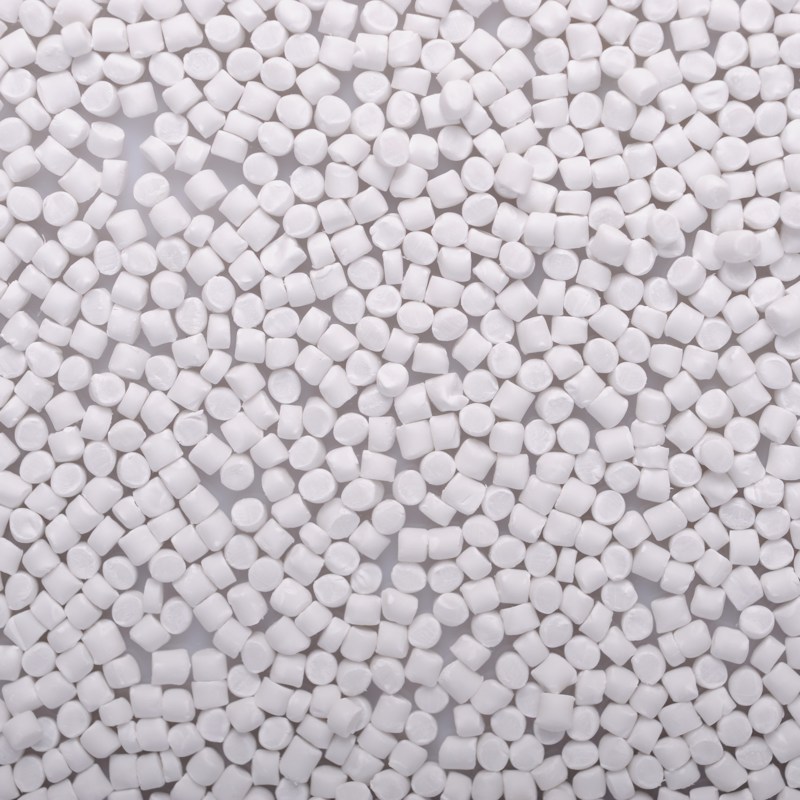
Compounders produce white masterbatch in various standardized concentrations to serve distinct market sectors. A 40% loading suits thick injection-molded parts perfectly. These thick parts naturally block light due to their sheer physical mass. A 60% loading serves general-purpose blow molding applications incredibly well. It provides enough density to hide the contents of a plastic bottle without inducing unwanted brittleness.
High-end agricultural and packaging films often require 70% to 75% concentrations. These ultra-thin films need dense pigment packing to prevent transparency. Operating at these high concentrations requires exceptional manufacturing precision. The margin for error shrinks drastically when you pack this much inorganic material into a polymer carrier.
More pigment does not indefinitely guarantee a whiter product. The relationship features a strict and unavoidable plateau. Pushing TiO2 content from 70% to 80% creates almost no visual difference in thin films. The physical particles become too crowded within the polymer chains.
Crowded particles begin to overlap geometrically. They share the same light-scattering space. We refer to this phenomenon as the crowding effect. It drastically reduces individual particle efficiency. You pay top dollar for extra pigment but gain zero visual benefit. Furthermore, this extreme loading creates highly brittle end products. The excessive mineral content actively disrupts polymer chain entanglement. Your products will fail under basic impact testing.
Your product thickness absolutely dictates your ideal pigment loading threshold. Use the comprehensive chart below to match your specific application to the correct concentration tier. This matrix helps prevent over-engineering your costly formulations.
Table 1: TiO2 Concentration Matrix Based on Product Thickness
| Application Type | Typical Thickness Range | Recommended TiO2 Loading | Operational Justification |
|---|---|---|---|
| Agricultural Thin Films | Under 50 microns | 70% - 75% | Demands maximum light scatter in minimal space to protect crops from intense UV exposure. |
| Blown Packaging Bottles | 1 to 3 millimeters | 50% - 60% | Balances moderate wall thickness against the rigorous structural needs of liquid containment. |
| Injection Molded Parts | Over 3 millimeters | 30% - 40% | Thick walls provide natural opacity; higher loading causes severe brittleness and part failure. |
| Thermoformed Sheets | 0.5 to 1.5 millimeters | 40% - 50% | Requires moderate hiding power without compromising essential deep-draw stretching capabilities. |
Absolute concentration means nothing without perfect particle dispersion. Poorly dispersed TiO2 particles inevitably clump together during the initial compounding phase. We call this severe clumping agglomeration. It destroys white masterbatch opacity rapidly and irreversibly.
Agglomerates act as single large particles rather than millions of efficient microscopic reflectors. They drastically reduce the effective surface area available for light scattering. A 70% loaded product suffering from agglomeration can look identical to a 40% loaded product. The expensive pigment sits uselessly trapped inside tight mineral clumps. These clumps also create dangerous stress concentrations within the finished plastic part. They act as initiation points for cracks and catastrophic mechanical failures.
High-loading combined with low-dispersion destroys production runs consistently. You will notice immediate physical and visible failures on the extrusion line. Watch out for these highly specific defect indicators during your quality control checks:
Buyers must heavily scrutinize their supplier's internal compounding process. Look for manufacturers utilizing advanced co-rotating twin-screw extrusion equipment. Twin-screw systems provide the intense, targeted shear force strictly needed to break apart stubborn agglomerates. Single-screw extruders simply cannot mix high-percentage TiO2 formulations adequately.
Additionally, evaluate the supplier's carrier resin wetting capabilities. High-quality manufacturers use specialized low-molecular-weight waxes and proprietary additives. These additives coat individual pigment particles completely. Proper coating prevents the particles from recombining after exiting the extrusion die. It ensures the pigment remains perfectly suspended indefinitely.
Nominal supplier claims rarely match delivered reality perfectly. A standard specification sheet promising 70% TiO2 might only deliver 65% active pigment in practice. The remaining 5% often consists of cheap fillers hiding within the blend. Smart buyers always trust standardized laboratory testing over basic marketing documents.
Implementing an internal testing protocol protects your material budget. It holds your suppliers directly accountable for every batch they deliver. You cannot troubleshoot opacity issues accurately if you do not know your true baseline pigment metrics.
Industry standards dictate highly specific ways to verify pigment weight and structural distribution. Implement these testing procedures to guarantee consistent material quality:
Every specific manufacturing process imposes distinct thermal and mechanical stresses on the polymer melt. You must evaluate highly specific operational criteria to find the absolute ideal formula for your factory floor.
Film extrusion demands incredibly strict performance limits from additives. You need extremely high dispersion to prevent lacing in sub-50-micron films. You also need massive hiding power at very low let-down ratios to maintain film elasticity. Furthermore, strict moisture control prevents volatile bubbles from tearing the ultra-thin polymer web during the blowing process. Any trapped moisture flashes to steam, ruining the entire roll.
Injection and blow molding prioritize entirely different processing factors. Flow characteristics become the primary concern. The molten polymer must fill complex, multi-cavity molds rapidly without freezing prematurely. Thermal stability ensures the pigment survives longer cycle times inside heated runner systems. You must select a specific carrier resin perfectly matching your base polymer's melt flow index.
Chemical manufacturers process bulk TiO2 into two distinct crystalline structures for industrial use. Rutile forms the undeniable industry baseline for highly durable applications. It delivers a vastly superior refractive index compared to other options. It also provides excellent inherent UV stability for demanding outdoor products like agricultural films or stadium seating.
Anatase offers a slightly bluer, brighter undertone favored in some niche indoor packaging. However, it falls significantly short in UV resistance. Anatase actively promotes rapid polymer degradation when exposed directly to intense sunlight. It acts as a photocatalyst, destroying polymer chains. Always demand a pure rutile titanium dioxide masterbatch for exterior, long-term applications to ensure product survival.
True covering power relies entirely on two connected, non-negotiable pillars. You must balance pure TiO2 concentration against absolute microscopic dispersion quality. Buying high-percentage pigment blends guarantees nothing if the individual particles clump together. Agglomeration wastes your material budget and causes severe structural defects in the final application.
Always match your selected formulation rigorously to your specific processing method. Thin agricultural films demand completely different rheology and dispersion profiles compared to thick molded parts. Treat physical thickness, barrel temperature, and carrier compatibility as your guiding technical metrics. Never rely on pigment percentage as the sole indicator of quality.
Take immediate action to protect your current production runs. Request updated, detailed Technical Data Sheets from your primary suppliers today. Demand relevant safety certifications like FDA or REACH compliance for food-contact applications. Finally, secure physical material samples and run rigorous in-house drawdown testing before ever committing to large-scale commercial orders.
A: No, increasing your dosing rate poses severe mechanical and financial risks. Flooding your extruder with a cheap, heavily filled formula aggressively displaces your primary base polymer. This compromises critical tensile strength and impact resistance. It also introduces excess carrier resin, which fundamentally changes melt flow dynamics. This shift increases overall cooling cycle times and ultimately slows down your entire production line.
A: Carrier resin strictly dictates polymer compatibility and pigment distribution behavior. If the carrier resin features an incompatible melt flow index, the pigment will not distribute uniformly within the melt. Poor distribution creates visible streaks, ghosting, and mechanical weak spots. A perfectly matched carrier ensures complete pigment wetting. This breaks down stubborn agglomerates for maximum light scattering efficiency.
A: Yellowing typically stems from severe thermal degradation during processing. Cheap carrier resins burn easily under high shear heat inside the barrel. Additionally, missing optical brighteners or mistakenly using anatase TiO2 outdoors dramatically accelerates yellowing. Always verify your purchased compound contains adequate, high-quality heat stabilizers specifically rated for your exact extrusion temperature profile.
A: CaCO3 serves strictly as a volumetric filler, not a primary opacifier. Its low refractive index means visible light passes through it easily. Substituting TiO2 with CaCO3 destroys your product's hiding power. Overusing it to chase cost reductions also drastically reduces the physical strength, flexibility, and tear resistance of your final plastic product.
